


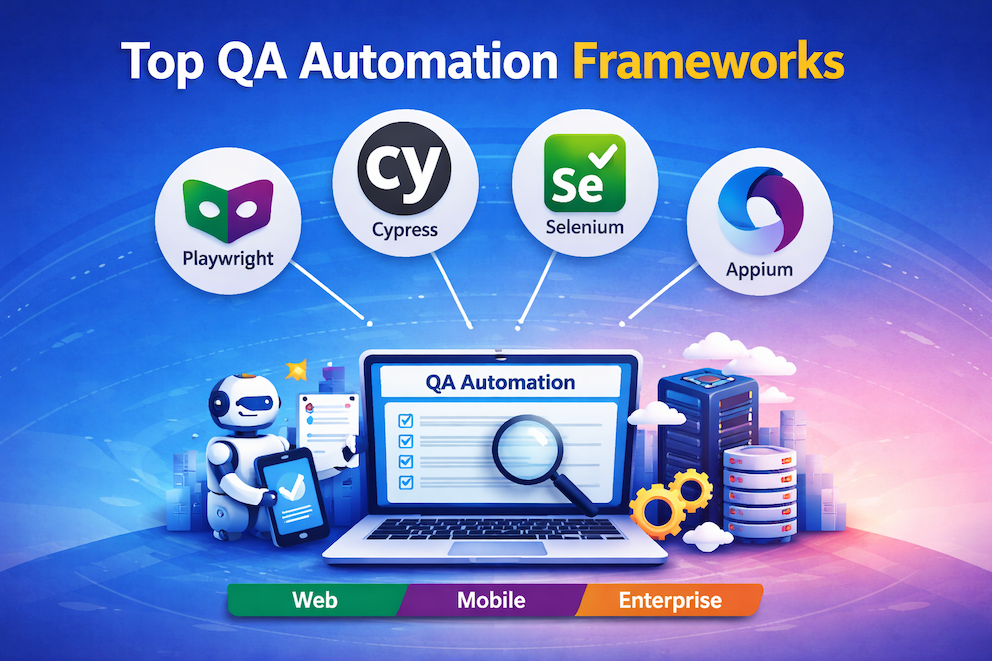
Introduction
Automation has become a cornerstone of modern Quality Assurance. With faster release cycles, complex architectures, and growing user expectations, choosing the right QA automation framework is critical for delivering high-quality software.
But with so many tools available, how do you decide which one fits your team best?
In this article, we explore the top QA automation frameworks, their strengths, and when to use them.
What is a QA Automation Framework?
A QA automation framework is a structured approach that combines tools, libraries, and best practices to create, execute, and maintain automated tests efficiently.
A good framework should provide:
-
Reusability and scalability
-
Easy maintenance
-
Clear reporting
-
Integration with CI/CD pipelines
Top QA Automation Frameworks
1. Playwright
Best for: Modern web applications, end-to-end testing
Playwright has quickly become one of the most popular frameworks due to its speed, reliability, and cross-browser support.
Key features:
-
Supports Chromium, Firefox, and WebKit
-
Built-in auto-waiting (reduces flaky tests)
-
Parallel execution out of the box
-
Powerful network interception and mocking
-
Great for CI/CD integration
Why teams love it:
It significantly reduces test flakiness and maintenance effort, making it ideal for fast-moving teams.
2. Cypress
Best for: Frontend testing, developer-friendly workflows
Cypress is widely known for its simplicity and excellent developer experience.
Key features:
-
Real-time test execution in the browser
-
Automatic waiting
-
Easy debugging with time-travel UI
-
Strong documentation and community
Limitations:
-
Limited cross-browser support (compared to Playwright)
-
Not ideal for multi-tab or complex scenarios
3. Selenium
Best for: Enterprise-level testing, legacy systems
Selenium is one of the oldest and most widely used automation frameworks.
Key features:
-
Supports multiple programming languages
-
Works across all major browsers
-
Massive ecosystem and community
Limitations:
-
Requires more setup and maintenance
-
Tests can be slower and more flaky without proper design
4. Appium
Best for: Mobile application testing (iOS & Android)
Appium is the go-to framework for mobile automation.
Key features:
-
Cross-platform mobile testing
-
Supports native, hybrid, and mobile web apps
-
Uses WebDriver protocol
Why it stands out:
It allows teams to reuse test logic across platforms.
How to Choose the Right Framework
Choosing the right tool depends on your project and team needs. Consider the following:
1. Tech Stack
JavaScript/TypeScript → Playwright, Cypress
-
Java/Python → Selenium.
2. Application Type
Web apps → Playwright, Cypress, Selenium
-
Mobile apps → Appium
3. Team Experience
Developers involved → Cypress, Playwright
-
Mixed skill levels → Selenium
4. Test Stability Requirements
High stability → Playwright
-
Flexible but requires setup → Selenium
Playwright vs Cypress vs Selenium (Quick Comparison)
| Feature | Playwright | Cypress | Selenium |
|---|---|---|---|
| Cross-browser | ✅ Full | ⚠️ Limited | ✅ Full |
| Speed | 🚀 Fast | 🚀 Fast | 🐢 Slower |
| Flakiness | Low | Medium | Higher (if not optimized) |
| Setup complexity | Medium | Easy | High |
| Best for | Modern apps | Frontend | Enterprise |
Trends in QA Automation Frameworks
The QA landscape is evolving rapidly. Key trends include:
AI-assisted testing (self-healing tests, smart selectors)
-
Shift-left testing (testing earlier in development)
-
CI/CD-first approach
-
Low-code/no-code tools
Frameworks that adapt to these trends will dominate the future.
Conclusion
There is no “one-size-fits-all” QA automation framework. The best choice depends on your team’s skills, application complexity, and long-term goals.
However, modern frameworks like Playwright and Cypress are leading the way with improved developer experience and reduced maintenance overhead, while Selenium and Appium remain strong in enterprise and mobile testing.
The key is to choose a framework that not only fits your current needs, but can scale with your product.