


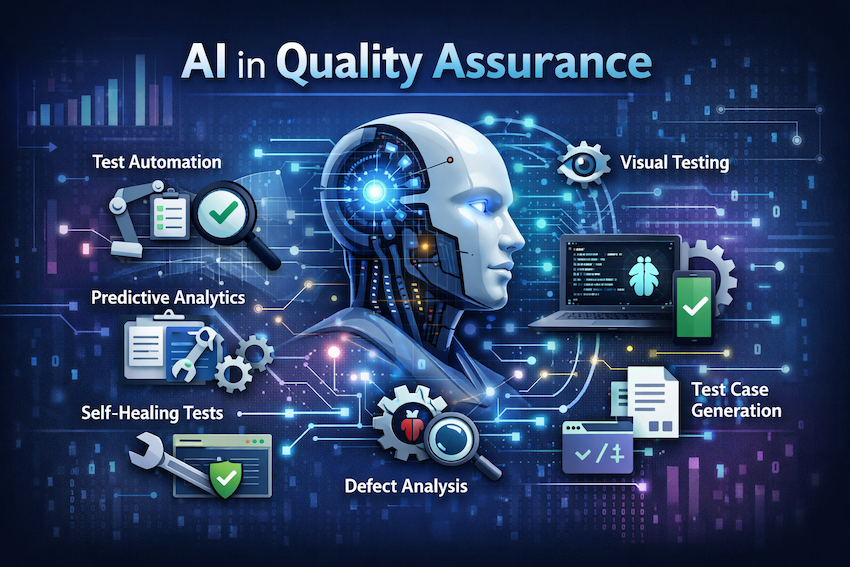
AI in Quality Assurance: Transforming Software Testing
Introduction
Quality Assurance (QA) has always been a critical part of software development, ensuring that products meet user expectations and function reliably. However, as applications become more complex and release cycles faster, traditional testing approaches are struggling to keep up.
This is where Artificial Intelligence (AI) steps in. AI is transforming QA by automating repetitive tasks, improving test coverage, and enabling smarter decision-making. In this article, we explore how AI is reshaping Quality Assurance and what it means for modern QA teams.
What is AI in Quality Assurance?
AI in Quality Assurance refers to the use of machine learning algorithms, data analytics, and intelligent automation to enhance testing processes. Instead of relying solely on predefined scripts and manual efforts, AI-powered systems can learn from data, adapt to changes, and make predictions.
This allows QA teams to move from reactive testing to proactive quality management.
Key Applications of AI in QA
1. Intelligent Test Automation
Traditional automation requires constant maintenance, especially when UI or workflows change. AI-powered tools can:
-
Automatically update test scripts when UI elements change
-
Identify the most stable selectors
-
Reduce flaky tests
This significantly lowers maintenance effort and improves test reliability.
2. Predictive Analytics
AI can analyze historical test data to:
-
Identify high-risk areas of the application
-
Predict where bugs are most likely to occur
-
Prioritize testing efforts
This helps QA teams focus on what matters most instead of testing everything equally.
3. Self-Healing Tests
One of the biggest challenges in automation is test fragility. AI enables self-healing tests by:
-
Detecting changes in UI elements
-
Automatically adjusting locators
-
Continuing test execution without failure
This reduces downtime and increases confidence in automation suites.
4. Visual Testing
AI-driven visual testing tools can:
-
Detect UI inconsistencies
-
Compare layouts across devices and browsers
-
Identify pixel-level differences
This is especially useful for responsive and design-heavy applications.
5. Test Case Generation
AI can automatically generate test cases based on:
-
User behavior
-
Application logs
-
Requirements or user stories
This improves coverage and uncovers edge cases that might be missed manually.
6. Defect Analysis and Root Cause Detection
AI helps in:
-
Clustering similar defects
-
Identifying root causes faster
-
Reducing duplicate bug reports
This speeds up triage and improves collaboration between QA and development teams.
Benefits of AI in QA
Implementing AI in QA brings several advantages:
-
Faster testing cycles – Reduced manual effort and smarter automation
-
Improved accuracy – Fewer human errors and better defect detection
-
Cost efficiency – Less maintenance and optimized resource usage
-
Better test coverage – AI explores more scenarios and edge cases
-
Data-driven decisions – Insights based on real usage and historical data
Challenges and Limitations
Despite its advantages, AI in QA is not without challenges:
-
Initial setup cost – AI tools can be expensive and require integration effort
-
Learning curve – Teams need to understand AI concepts and tools
-
Data dependency – AI models require quality data to perform well
-
Not a full replacement – Human intuition and exploratory testing remain essential
AI vs Traditional QA: A Shift, Not a Replacement
AI does not replace QA engineers—it enhances their capabilities.
QA professionals can shift focus from repetitive execution to:
-
Exploratory testing
-
Strategy and test design
-
Risk analysis
-
Collaboration with product and engineering teams
In other words, AI helps QA engineers become more strategic and impactful.
The Future of AI in QA
The role of AI in QA will continue to grow, with trends such as:
- Autonomous testing systems
- AI-driven CI/CD pipelines
- Natural language test creation
- Real-time quality monitoring in production
Organizations that adopt AI early will gain a competitive advantage by delivering higher-quality software faster.
Conclusion
AI is redefining Quality Assurance by making testing smarter, faster, and more efficient. While it comes with challenges, the benefits far outweigh the drawbacks when implemented correctly.
For QA teams, the key is not to resist AI—but to embrace it as a powerful tool that enhances their skills and elevates their role in the software development lifecycle.